

Elena Ray, Butterfly Ink Study
premarital & early marriage counseling.
Dialogue therapy for engaged and newly married couples.
Falling in love and building a life together are not quite the same thing.
Engagement and the early years of marriage offer couples a unique opportunity to understand not only who they are together, but what each person brings into the relationship from the life they lived before they met.
Every partner enters a marriage with a relational history. Family-of-origin experiences, attachment patterns, previous relationships, personality differences, and ways of responding to stress and conflict all become part of the relationship—often without our realizing it.
Premarital and early-marriage counseling offers couples the opportunity to explore these patterns before misunderstandings and resentments become deeply established.
My approach to this work is grounded in Dialogue Therapy and informed by attachment theory, mindfulness, Emotionally Focused Therapy, and Jungian depth psychotherapy. Rather than offering a checklist of topics couples should agree upon before marriage, we explore something deeper: How the two of you will remain in relationship when you do not agree.
Exploring your past, present, & future.
Together, we explore three interconnected parts of your relationship:
Your Past.
What did each of you learn about love, conflict, intimacy, money, family, independence, vulnerability, caregiving, spirituality, and power in the relationships that shaped you?
Your Present.
What patterns are already emerging between you? What happens when one of you feels hurt, criticized, misunderstood, controlled, rejected, or disconnected? How do your attachment needs, personality differences, and individual threat responses interact?
Your Future.
What kind of marriage do you want to create? Which patterns and traditions do you want to carry forward—and which would you like to change?
The goal is not to determine whether your histories or personalities are compatible. It is to understand them well enough that you can make conscious choices about the relationship you are creating together.
Learning how to dialogue.
Dialogue Therapy teaches couples to approach differences with greater awareness and curiosity with three foundational skills:
Speaking for Self.
Expressing your own experience, feelings, needs, and perceptions rather than defining your partner's intentions or character.
Listening Mindfully.
Listening to understand your partner's experience rather than preparing a defense, rebuttal, correction, or solution.
Remaining Curious.
Developing the ability to wonder about what is happening within yourself, within your partner, and between the two of you, particularly when you experience something differently.
The purpose of dialogue is not to eliminate disagreement. It is to help couples develop a relationship in which difficult conversations can occur without difference automatically becoming disconnection.
understanding what happens when you are triggered.
I introduce the Snow Globe Effect to help couples understand what happens when something in the relationship activates an old fear, attachment wound, or threat response.
Each of us experiences relationships through a subjective lens shaped by our histories, memories, beliefs, expectations, and ways of protecting ourselves. When the snow globe gets shaken, emotions and defenses can begin swirling, making it difficult to see beyond our own interpretation of what is happening.
Your partner has a snow globe, too.
Part of our work is learning to recognize what shakes each person's snow globe—and what helps the snow settle again. Couples can begin responding to the vulnerability underneath a reaction rather than becoming caught in the reaction itself.
With attention, curiosity, and dialogue, couples can move beyond simply preparing for marriage toward consciously creating the marriage they want to inhabit.
Conversations that matter.
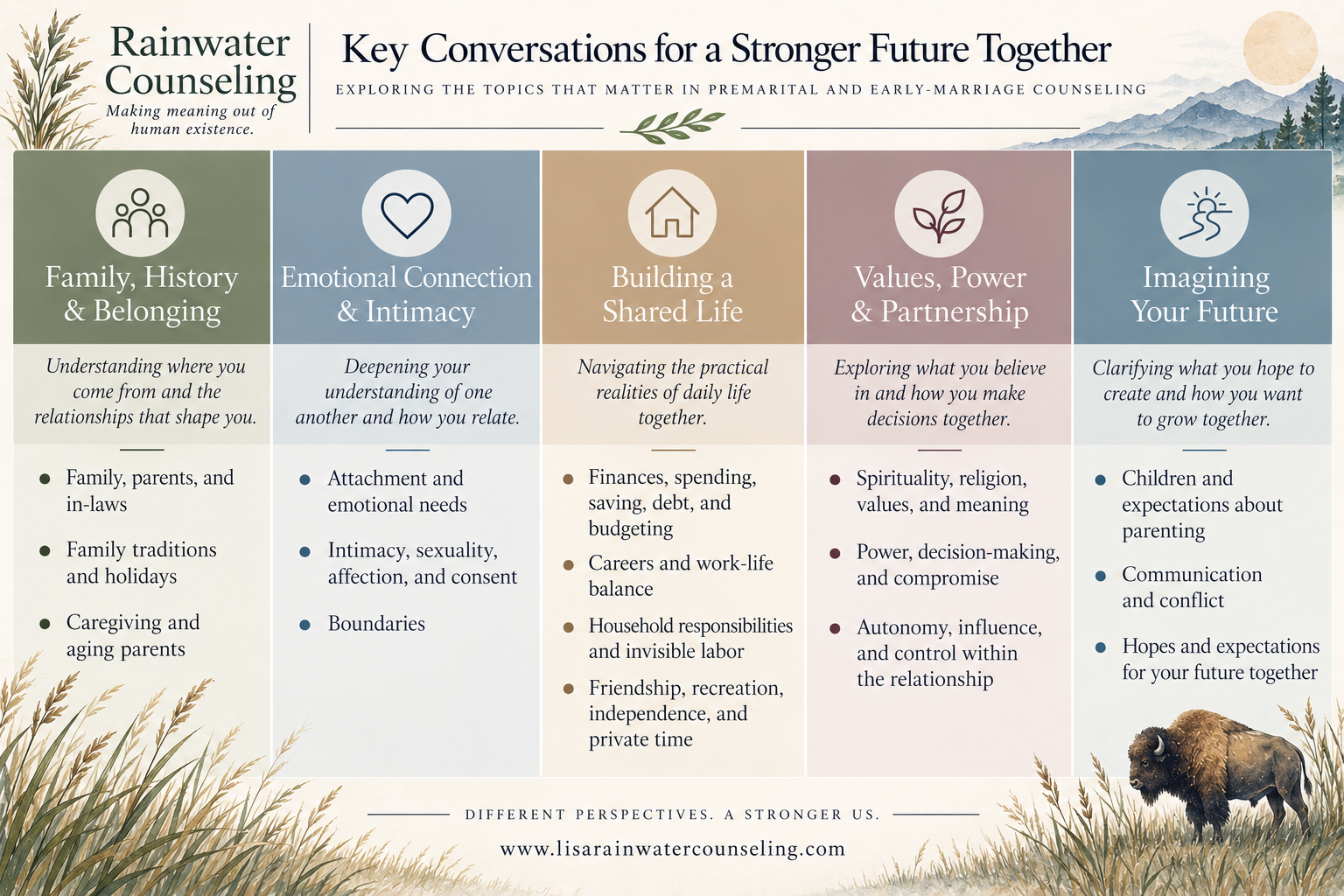
With attention, curiosity, and dialogue, couples can move beyond simply preparing for marriage toward consciously creating the marriage they want to inhabit.
Premarital & Early Marriage Counseling in Winston-Salem, NC
I offer in-person premarital and early-marriage counseling for engaged and newly married couples in Winston-Salem, North Carolina.
If you are considering premarital counseling, are preparing for marriage, or are in the early years of building a life together, I invite you to schedule a complimentary 30-minute consultation to explore whether Dialogue Therapy may be a good fit for you.
creating the marriage you want to inhabit.
A wedding asks you to make a commitment to one another.
A marriage asks you to continue discovering what that commitment means as both of you grow and change.
Engagement and early marriage provide an opportunity to become intentional about your relationship before your patterns become entrenched.
Premarital and early-marriage counseling offers a place to begin that process intentionally: Understanding where each of you has come from, becoming more aware of who you are together, and thoughtfully considering the relationship you want to create for the years ahead.
Premarital & Newlywed Couples Therapy with Lisa.
Deepening Connection, Trust, and Intimacy.
Premarital and newlywed couples therapy is a collaborative, time-limited process designed to help partners understand one another more deeply, communicate more effectively, and strengthen the emotional bond that sustains their relationship. My work integrates Dialogue Therapy, Emotionally Focused Therapy (EFT), Jungian Depth Psychotherapy, and Mindfulness—four complementary approaches that address both the practical and the emotional dimensions of love, conflict, and repair.
Rather than fostering dependence on the therapist, our work helps you become experts in your own relationship—to carry forward new insights, communication skills, and relational awareness that empower you to navigate conflict and connection with confidence and compassion.
Structure & Duration.
Premarital and newlywed couples therapy with Lisa typically consists of twelve to seventeen 55-minute sessions, with a six-month follow-up to support integration and closure. A three-month follow-up is also available as needed.
The therapeutic process may include:
Evaluation of the Relationship (4–6 sessions) – Understanding patterns, strengths, and areas for growth.
Working Through Conflict (5 sessions) – Practicing skills to de-escalate tension and enhance mutual understanding.
Empathy and Emotional Connection (2 sessions) – Cultivating compassion and responsiveness to each other’s needs.
Integration and Refinement (2 sessions) – Reinforcing communication tools and deepening emotional intimacy.
Mindfulness and Creative Reflection (woven throughout) – Engaging in practices such as kintsugi, composition work, and mindfulness song listening to enhance presence, compassion, and insight. These reflective exercises help couples slow emotional reactivity, find beauty in imperfection, and integrate new awareness into daily life.
An Inclusive Space for Every Couple.
Premarital and newlywed counseling is open to couples of all backgrounds, orientations, and relationship structures—heterosexual or LGBTQIA+, long-term partners and those newly navigating life together. Our sessions provide a compassionate and nonjudgmental space to explore what love asks of you both.
Every relationship holds the possibility of growth, and it begins with two people willing to listen, learn, and begin again.
What matters is developing the capacity to talk about what matters, understand why it matters to each of you, and negotiate differences with respect and curiosity.
Schedule an appointment.
Beginning therapy is a meaningful step. You are welcome to select a time for a complimentary consult or session, and I will meet you there with care, presence, and clinical expertise. After you choose a time, your request will be carefully reviewed. You will receive a confirmation of your appointment or, if needed, a follow-up with alternative scheduling option.


Certification in Jungian and Post-Jungian Clinical Concepts
Helpful Blog Posts.
Before “I Do” and Beyond: Building a Marriage through Dialogue
Speaking for Yourself: A Core Practice in Dialogue Therapy for Couples
Listening Mindfully: The Second Pillar of Dialogue Therapy
Remaining Curious: The Third Pillar of Dialogue Therapy for Couples
Embracing the Presence of the Other
Communication, Curiosity, and the Power of "Yes, And"
Peering Outside Your Snow Globe, Mindfully
How are My Defenses Impacting My Relationships?
Am I Engaging in Projective Identification?