When Loss Reorders the Inner World.
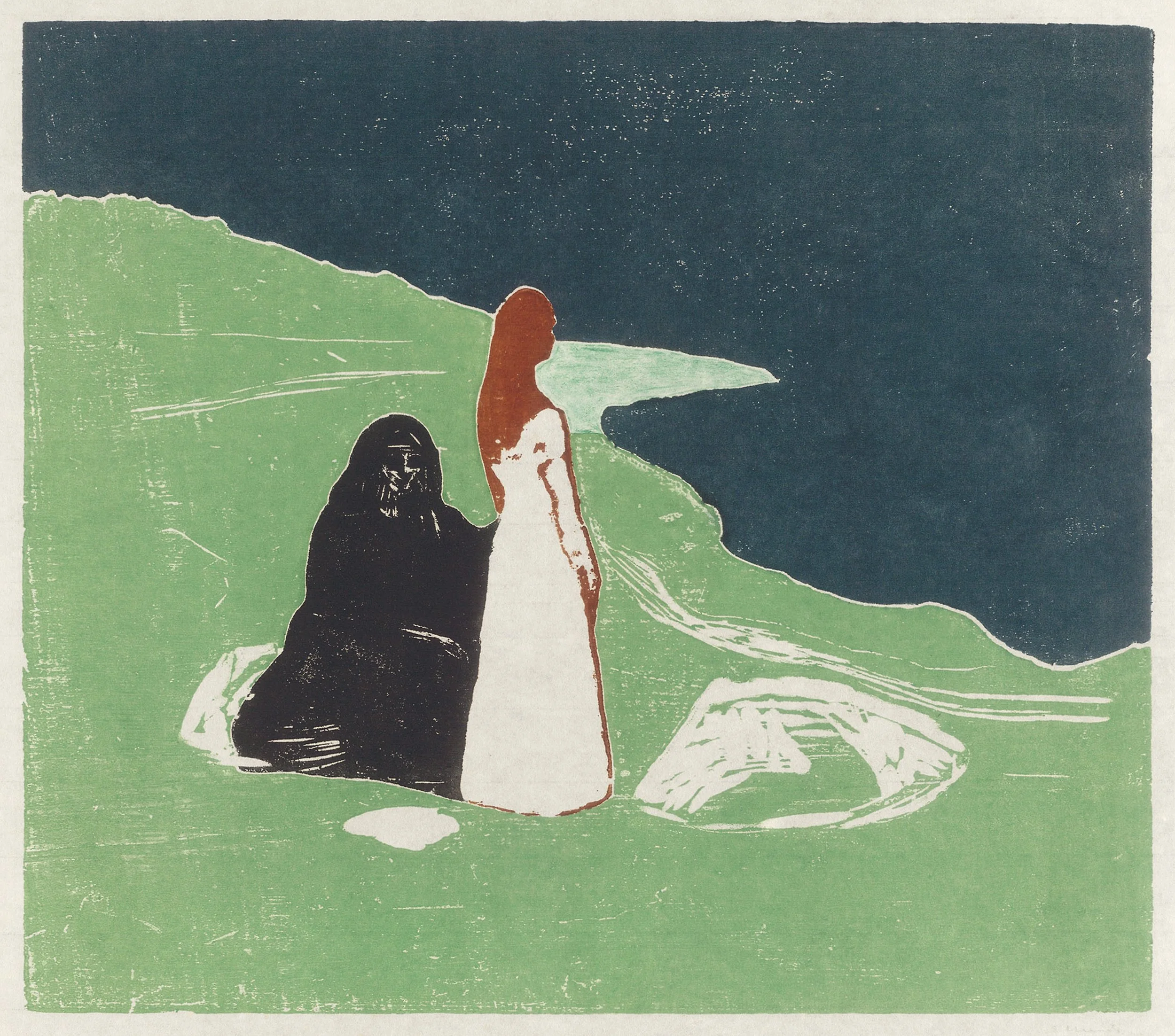
Two Women on the Shore (1898) by Edvard Munch.
How grief reshapes attachment, identity, and the inner landscape.
In depth psychotherapy, loss is not understood as an event to be “worked through” and left behind, but as a threshold that reorganizes the psyche. Grief alters the internal landscape: time, memory, identity, and meaning are subtly—and sometimes violently—rearranged. Early psychoanalytic theory attempted to describe this process through the concept of decathexis. In Mourning and Melancholia, Sigmund Freud (1917/1957) proposed that mourning requires the gradual withdrawal of libidinal energy from the lost object so that it might be reinvested elsewhere. While clinically influential, this formulation can feel insufficient when held against the lived reality of grief. What many patients experience is not a clean withdrawal of love, but a painful and uneven restructuring of attachment itself.
From a depth-psychological perspective, this is because loss does not remain confined to the personal unconscious.
In Symbols of Transformation, Carl Gustav Jung distinguishes between two layers of the unconscious: the personal and the impersonal, or transpersonal. The personal unconscious contains lost memories, repressed affects, subliminal perceptions, and contents not yet ripe for consciousness; it corresponds to what Jung elsewhere names the shadow. Beyond this layer lies the collective unconscious—a psychic stratum that is “detached from anything personal” and common to all humanity (Jung, 1956/1912, ¶103).
Jung further emphasizes that within every individual there exist not only personal memories, but what he calls “primordial images”—inherited possibilities of imagination that have existed from time immemorial (Jung, 1956/1912, ¶101). These are not inherited ideas, but inherited forms: archetypal patterns that shape how human beings experience birth, love, loss, death, and transformation. This framework helps explain why symbolic motifs recur across cultures and epochs—and why, in clinical work, patients may spontaneously produce images, dreams, and associations that echo ancient mythological material without conscious exposure.
Grief often marks the moment when this deeper layer of the psyche is constellated.
What begins as a personal loss—my beloved, my body, my future—frequently expands into something larger and more unsettling. Individuals describe a sense that the world itself has changed; familiar meanings collapse; time feels distorted; identity loosens. From a Jungian lens, this is not regression, but initiation. Loss presses the psyche beyond personal biography and into archetypal territory, where death is no longer only an event but a fundamental dimension of existence.
This movement finds a striking parallel in the work of German poet Rainer Maria Rilke, who writes that through “great, immoderate loss” we are introduced into the Whole, and that death is an unsparing way of placing us on intimate and trusting terms with that side of our existence that is turned away from us (as quoted in Baer, 2014, p. 115). Rilke famously interrupts himself to wonder whether the emphasis should fall on our or on existence. He cannot choose—because grief collapses that distinction.
Loss implicates the individual ego while simultaneously exposing the transpersonal ground of being.
Clinically, this helps explain why grief cannot be reduced to symptom resolution or emotional regulation alone. Dreams intensify. Symbolic material emerges. The dead may appear imaginally—not as hallucinations, but as meaningful inner presences. Individuals are not “holding on” in a pathological sense; they are negotiating a new psychic relationship between personal attachment and archetypal continuity.
Here, Jung’s model offers a corrective to a purely decathectic view of mourning. Love does not simply withdraw; it changes location. The relationship does not end; it is internalized, symbolized, and transformed. Mourning, then, is not the severing of bonds, but their reconfiguration across levels of the psyche.
In this sense, grief is not an interruption of psychological life but a deepening of it.
Loss forces an encounter with what Jung called the objective psyche and what Rilke named the Whole. It presses the individual into greater intimacy with both personal vulnerability and transpersonal meaning.
Depth psychotherapy does not aim to hasten this encounter or resolve its tensions. Its task is more exacting and more humane: to help individuals hold the paradox—to remain in relationship with loss without collapsing into despair or bypassing into abstraction. When adequately supported, grief can become not only survivable, but transformative: an unsparing teacher that enlarges the soul’s capacity to live, love, and endure.
Notes.
Baer, U. (2014). The poet’s guide to life: The wisdom of Rilke. New York, NY: Random House.
Freud, S. (1957). Mourning and melancholia. In J. Strachey (Ed. & Trans.), The standard edition of the complete psychological works of Sigmund Freud (Vol. 14, pp. 237–258). London: Hogarth Press. (Original work published 1917)
Jung, C. G. (1956). Symbols of transformation (2nd ed., R. F. C. Hull, Trans.). In The collected works of C. G. Jung (Vol. 5). Princeton, NJ: Princeton University Press. (Original work published 1912)

If you are moving through loss and feel altered by it—uncertain, undone, or quietly changed—you don’t have to carry that alone. I offer depth-oriented psychotherapy for those seeking to live in honest relationship with grief and meaning.

Lisa A. Rainwater, PhD, MA (couns), LCMHC, CCMHC, CCTP, CT is a depth psychotherapist and founder of Rainwater Counseling in Winston-Salem, North Carolina. Licensed in North Carolina, Colorado, and Wisconsin, she works with individuals, couples, and groups.
Lisa worked for five years as a psychosocial oncology counselor at Atrium Health Wake Forest Baptist, where she supported patients, families, caregivers, and providers navigating cancer, loss, and end-of-life transitions. She is a Certified Dialogue Therapist for Couples, Certified Thanatologist, Certified Clinical Trauma Professional, and Eagala-Certified Equine Assisted Psychotherapist, integrating psychoanalytic, mindfulness-based, and experiential approaches to foster healing and reconnection.
Holding a PhD in German and Scandinavian Studies from the University of Wisconsin–Madison and a master’s in Counseling from Wake Forest University, Lisa’s work bridges mythology, depth psychology, and existential meaning-making. She recently completed Finding Ourselves in Fairy Tales: A Narrative Psychological Approach at Pacifica Graduate Institute and continues advanced studies through the Centre for Applied Jungian Studies.
She is licensed to practice in North Carolina, Colorado, and Wisconsin.